audit · June 23, 2026 · 9 min
Why Your Website Costs You Revenue: 5 Conversion Leaks
Five named leaks where seven-figure firms lose enquiries before anyone ever sees the contact form. With the numbers that prove the principle.
By Dennis L. Bernhard, Founder, Market Value Advisory
Your website gets traffic. Ads run, SEO slowly bites, people arrive. And still the pipeline does not fill. Before you raise the ad budget again, you should know the five spots where a seven-figure firm's website loses enquiries before anyone ever sees the contact form. This is rarely a traffic problem. It is a friction problem.
Friction is silent. Nobody writes to tell you "your page took 1.2 seconds too long to load, so I left". The visitor is simply gone, and your analytics shows a bounce that explains nothing. The five leaks below explain most of those silent exits.
First, one thing about the numbers
The hardest, cleanly measured numbers on conversion friction come from e-commerce. The reason is simple: in an online shop you measure every drop-off straight against revenue, across millions of sessions, in A/B tests. On a B2B site with one contact form and 40 enquiries a month, you do not have that statistical sharpness. So treat the numbers below as what they are: this is how clearly friction shows up in e-commerce. The same mechanic acts on your contact form, just more invisibly. A person who abandons an 80-euro cart over friction abandons a 40,000-euro enquiry the same way. The gut does not know the order value.
Leak 1: The page loads too slowly
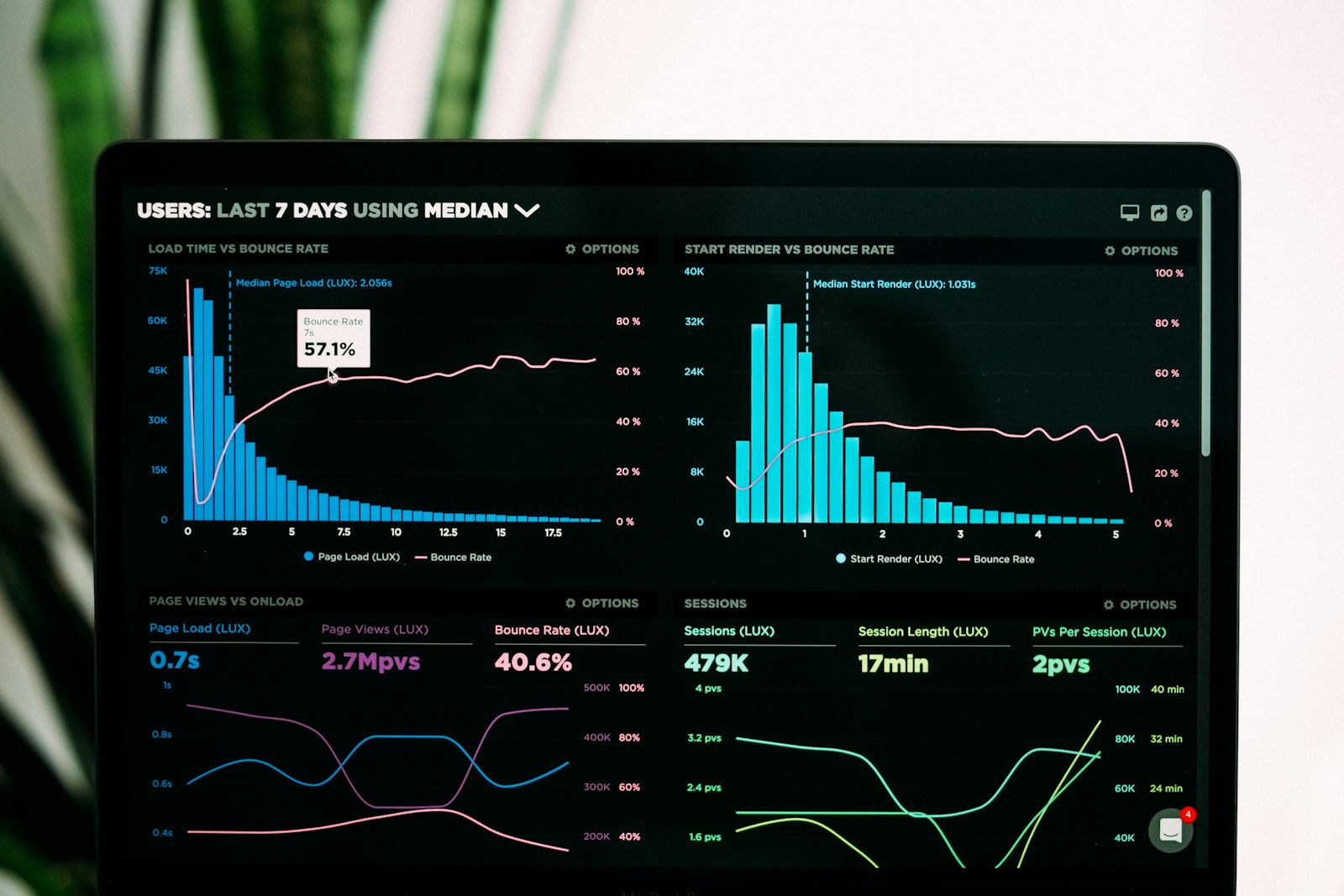
Speed is measurable, and Google has set a standard for it: the Core Web Vitals. Three values count. LCP, when the largest visible content has loaded, is good at 2.5 seconds or faster. INP, the response to input, should sit at 200 milliseconds or below. CLS, the layout shifting as it loads, should stay under 0.1. It is measured at the 75th percentile of real users, not in a lab (Google web.dev). In plain terms: three in four visitors have to see the good values, not the average.
Why this hits revenue hard shows in two data points. Google measured on its own mobile data that 53 percent of mobile visits are abandoned when a page takes longer than three seconds to load (Google, 2016). And the agency Portent found across 20 sites, 14 of them B2B lead-gen, that a site loading in one second converts three times as well as one loading in five (Portent, 2022). That is correlation, not an A/B test; fast sites are often better built in other ways too. But the direction is unambiguous.
A word on the source, because honesty belongs here: the 53-percent figure, and also the Google-commissioned Deloitte study "Milliseconds Make Millions" (2020), which tied 0.1 seconds more speed to 8.4 percent more conversion in retail (Deloitte, 2020), come from a company that sells speed as a ranking factor. That does not make the numbers wrong; they line up with independent measurements. But you should know who held the pen. Deloitte itself calls it a correlation, not a controlled test.
Leak 2: Mobile breaks the experience
The 53-percent figure above is a mobile figure. That is no accident. On a phone every friction is bigger: weaker connection, smaller screen, a thumb instead of a mouse. A page that feels acceptable on desktop can be unusable on mobile, and you do not notice, because you build and check your own site on the big monitor.
Across industries, the mobile conversion rate typically sits below the desktop one. That has been a known order of magnitude in the agency and analytics world for years, even if the exact gap shifts by source and sector. What matters for you is not the precise number but the consequence: if most of your visitors arrive on mobile and convert worse on mobile, the mobile experience is not a side stage. It is the main entrance, the one most people come through and the one most of them turn back at.
Leak 3: The value proposition does not land in seconds
Here is a principle that flips every assumption about your copy. Users do not read. The Nielsen Norman Group found, already in its classic study, that visitors on average read only around 20 to 28 percent of the words on a page (Nielsen Norman Group, 2008). They scan, they skip, they hunt in seconds for a reason to stay. If they do not find it, they are gone.
That means your value proposition has to land instantly, in the first words a person sees without scrolling. Not "we are your partner for holistic solutions". But, in one sentence, what you do better for whom than the obvious alternative. Most seven-figure firms waste their most valuable space, the top half of the homepage, on a beautiful shot and a slogan that promises nothing. A visitor who cannot tell in five seconds why you and not the cheaper option will not scroll on to find out. They just are not.
Leak 4: The form is too long
Every required field is a small hurdle, and hurdles add up. In e-commerce, the Baymard Institute measured that 18 percent of buyers abandon a purchase because the checkout is too long or too complicated (Baymard Institute). The average checkout shows around 15 actual form fields, even though 7 to 8 would almost always be enough. Every field you cut lowers the friction.
Carried over to B2B that means: your contact form is your checkout. If it demands name, company, role, phone, budget, timeline and a message before anyone has even spoken to you, you lose exactly the busy decision-makers you actually want. Ask for what you genuinely need for the first step, usually a name and one way to reach them. The rest you clear up in conversation, not in the form. Every field you ask for out of convenience for your own CRM, the prospect pays for with a piece of willingness.
Leak 5: Trust signals are missing
Trust is decided before the enquiry, not after. Again from e-commerce, because measurable there: 19 percent of buyers abandon because they do not trust the site with their payment data (Baymard Institute). In B2B visitors enter no credit card, but they hand over something that feels the same: their name, their number, the admission that they have a problem. They only do that if the site feels trustworthy.
And trust is visual and from the gut, not technical. A site that loads slowly, breaks on mobile and looks like 2014 sends a distrust signal before a single word is read. The reverse builds trust with real proof: concrete results, names and faces instead of stock photos, references that can be checked. One warning, and it is not boilerplate: do not invent trust signals. No made-up review counts, no fake voices, no third-party logos without permission, no "verified" badge without a verification. In Germany that is actionable under unfair-competition and trademark law, and an attentive visitor smells it anyway. Real trust comes from real proof, shown cleanly.
What these five leaks cost together
An honest worked illustration, not a promise and not a real client. It only shows the order of magnitude. Take a firm at 1 million euros in revenue that wins a relevant share of it through website enquiries. If the visitor-to-enquiry conversion sits at 1.5 percent today, and you close two of the five leaks far enough to lift it to 2.1 percent, that is a 40 percent rise in enquiries from the exact same traffic. What those 40 percent mean in revenue depends on your order value and close rate, but it costs not one extra ad euro. The enquiries were there the whole time. They just drained out through the leaks.
For scale: B2B conversion rates sit, depending on the industry, roughly between 1.1 and 7.4 percent (First Page Sage). That is an agency range, not a law of nature, but it shows how much room lies between a badly and a well-built site. The difference between 1.1 and 4 percent is not "more traffic". It is a site that does not lose the people who are already there.
How we tackle it
We do not start with a redesign, we start with measurement. Where does conversion drop off, on which device, at which stage? Only once the leak is named do we build. That order is not negotiable, because a prettier page without a diagnosis is just more expensive, not better. It is the same logic as in why more marketing won't help: more volume against an open leak scales the loss, not the gain.
In the Web-Sprint we build the site on Next.js with a fixed performance budget, so the Core Web Vitals sit in the green from day one, mobile first. In the Performance-Lab we then measure each funnel stage on its own and correct where conversion actually breaks, instead of blindly pulling the budget up. The combination is the point: a fast site without funnel logic does not convert, and a good funnel on a slow site loses people before it can bite. How an agency optimises the ad account without touching the funnel, we break down in Performance-Lab, not ads agency.
So before you put the next euro into traffic: do you know how many enquiries your site is losing right now at these five leaks, or are you only guessing?
Traffic comes in, but the enquiries stay out? Before you raise the budget, have the five leaks on your site measured, that is usually where the lever sits.